





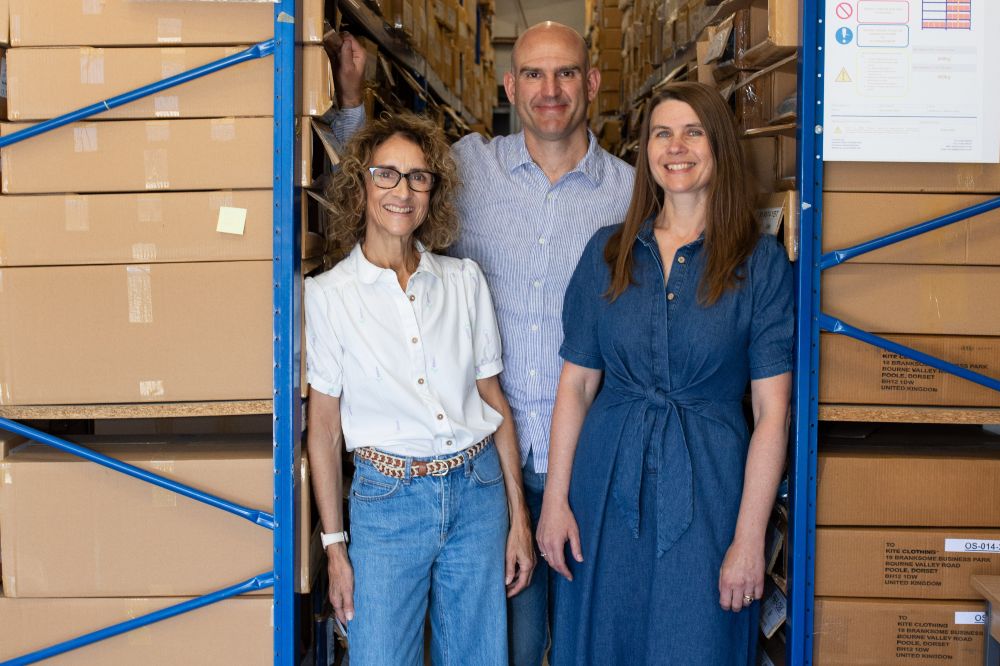
Kite Clothing is an award-winning, Dorset-based brand creating sustainable, organic clothes for children and women. As the business celebrates its 18th birthday, CWB’s Laura Turner sits down with company directors Jo Spragg, Ally Tyler and Roger Hakes, to reflect on the journey so far.
Laura Turner: Where did the idea for Kite come from?
Jo Spragg: I’d just had my third child and was ready to get back to work. I’d always worked in clothing-buying roles for bigger, more corporate companies, but I didn’t want to go back to that world. The guilt kept creeping in – I couldn’t ignore how unsustainable the fashion industry was. I wasn’t a full-blown eco-warrior, but I was environmentally conscious. So I thought, “If I can do something my girls would be proud of, that’s kinder to the planet, then it’s worth a go.” At the time, sustainability was still quite a new idea in fashion. For years, it felt like we were pushing against the tide. People wondered whether a sustainable brand could survive, but I believed in it.
LT: How did you turn your idea into reality?
JS: I had contacts in the industry, and through them I was introduced to Ayşe in Istanbul. She knew smaller factories that were willing to make small runs of high-quality clothing. That was crucial, because the big factories wouldn’t touch small quantities. Within four months, the first collection was ready – 14 styles, 60 pieces of each. I stored the boxes in my garage and sold them at school fairs and local markets. But then I hit a bit of a wall. The factory wanted more volume, which meant having to buy more and commit more. We made a big decision – we sold our house to release some capital and bought a much cheaper one that was a bit of a project. We didn’t do much with the business in 2008. I was deep into the house project and the business was almost on hold.
LT: But you relaunched in 2009?
JS: Yes, I decided to do a trade show on my own. Ally, a good friend I’d met at the school gates, said to me, “I’ve got one really big concern about this trade show, Jo. How are you going to go to the toilet?” I said, “What do you mean? I’ll just make it work.” But she said, “I’ve got a solution – my brother.”
Roger Hakes: I’d been working as a strategy consultant specialising in retail and consumer goods, but was looking for a startup or small business to get involved in. I came to Olympia to see what Jo was doing and help on the stand, and I thought, “This has real potential.” That meeting – essentially to cover toilet breaks! – was the start.
JS: Soon after, Roger, Ally, my husband Rich, and I decided to go for it properly. That year, the business turned over just £20,000, and we ran it out of a shed at the bottom of my garden. They were humble beginnings.
LT: What were those early years like?
JS: Tough but exciting. You’ve got no leverage at the start, and you need factories to take you seriously. Over time, we’ve built incredibly strong relationships with our suppliers – we’ve worked with all of them for more than 10 years now. That consistency, shared knowledge, and trust are one of the foundations of our success.
RH: The cash flow in the very early years was also a struggle. At one point, we were a million pounds in, which is a scary place to be. You have to go all in to grow a business and be confident that the return will come.
Ally Tyler: There was a lot of juggling. We had three and a half years in the shed, then moved into two tiny rooms above an estate agent in Ashley Cross. It was basic – a couple of rooms, a tiny kitchen and a loo – but it felt amazing. We hired our first employee there. Those were big moments. We also launched our new website in 2013.
RH: In 2014, moving into our current unit was a turning point. It gave us space, and we brought our distribution back in-house – suddenly, we had control of our stock again. It meant we could be so much more responsive. That same year, we won the UK Fashion and Textile Award, which felt huge for such a small business.
LT: Had you noticed increased interest in sustainability by then?
JS: Yes, by then we were GOTS certified, which we were really proud of. But it was a big commitment. I remember us asking, “Can we afford to stay GOTS certified?” It was expensive, especially for a small business; every step in the supply chain cost more, and it limited who we could work with. But the flipside of that is you build really strong relationships with your suppliers. It’s been a gradual process, and honestly, I think it’s only since Covid that we’ve seen more people actively seeking out sustainable brands.
LT: What challenges have you faced in the last 18 years?
RH: Like everyone, we’ve had our share: the financial crisis, Brexit, Covid, supply chain issues. But we’ve always been nimble and flexible, which helped us weather those storms.
AT: The last few years especially have been turbulent for retail, but what’s kept us going is our focus on quality – in both our products and our service. And we’ve been lucky to have such a supportive community around us. Our stockists, many of whom have become friends, and our customers, who leave incredible feedback – nearly 10,000 Trustpilot reviews with a 4.9 score – they’ve all been part of our journey.
LT: What are you most proud of?
JS: The quality of what we make. Clothes that wash well, wear well, and can be passed on. I love hearing stories of children wearing pieces that have been through three siblings and still look great.
RH: I’d say the relationships. With our suppliers, stockists and customers. And of course, our team – 35 amazing people at Kite HQ. We want to keep empowering them so the business grows through all of us.
AT: And the sense of community. Kite has always been about more than clothes. We’ve built a brand people can trust, that stands for sustainability, kindness and quality. That’s incredibly rewarding.
JS: Through it all, we’ve stuck to our values. We’ve been GOTS certified for 15 years running, our production has zero air miles, and we’re proud to work with suppliers whom we’ve known for over a decade. Those decisions have shaped Kite into what it is today.
LT: Has anything surprised you along the way?
JS: How hard it’s been. I still think, why isn’t it easier? Am I doing something wrong?!
RH: The truth is, if you look at 100 businesses that start out, maybe five of them get lucky and find it relatively easy. Seventy or 80 won’t survive the first few years, and then there’s maybe 20 or 30 that go on to become good, solid businesses. It’s really hard work to get there, but so rewarding if you manage to make it work.
JS: Yes, I am amazed, really, by just how much it’s grown. From boxes in my garage to supplying hundreds of stockists across the world – I couldn’t have imagined it back in 2007.
AT: And how much the sustainability conversation has changed. At the start, it felt niche. Now it’s mainstream. We’re proud to have been ahead of that curve, and we’ll keep spreading the word about why sustainable fashion matters.
LT: What advice would you give your 2007 selves?
JS: So many things. But really, I’ve no regrets.
AT: Prepare yourself for the long haul. We could never have imagined back then what this journey would look like.
RH: The challenge has been huge – as it is for most startups. But maybe that’s a good thing. If we’d understood just how big it would be, we might never have started. The truth is that things are only truly rewarding and satisfying if they’re challenging.
LT: What’s next for Kite?
JS: I just hope I’m as happy working here as I am now – maybe not working quite as hard though!
RH: We’ll keep doing what we’re doing – making better clothes in a better way. Growth, yes, but the right kind of growth – grounded in quality and values.
AT: The next phase is about further empowering the team. Like raising an 18-year-old – they still need you, but differently. That’s how we see the business now.
JS: Right at the start, Ally and I were walking back from the school run, having just agreed to go into partnership. As we said goodbye, I said, “It’s going to be so exciting, isn’t it?” And Ally replied, “It’s going to be an adventure.” And here we are, 18 years later – it’s definitely been an adventure.